


 Whatsapp
 Facebook
 X
X


An open call and two-stage evaluation to determine the project for the Türkiye Pavilion in the 20th International Architecture Exhibition has concluded. The Selection Committee, comprising Hülya Ertaş, Bilge Kalfa, Cem Sorguç, Melis Varkal, and Prof. Şebnem Yücel, evaluated 43 applications and selected the project titled ‘Spolia Futures’, curated by ba-be commons – consisting of Başak Eren, Asya Ece Uzmay, Beril Sarısakal Erkent, and Ece Yetim – to be exhibited at the Biennale. The finalist project was chosen from a shortlist of three proposals, each notable for its distinctive content and design ideas.
The Selection Committee explained its reason for selecting the project as follows: ‘‘‘Spolia Futures” exhibition stood out for its strong conceptual framework and its potential to bring spolia techniques specific to the geography of Türkiye into global architectural discourse. The project considers spolia – a method of construction that changes and transforms over time and renews its relevance through the incorporation of new elements – under the categories of coexistence, archiving, slowing down, repair and speculation about the future. The Pavilion, to be developed through research and collaborations with artists, focuses on how spolia will shape the architecture of the future.’
Spolia Futures approaches spolia not merely as a historical practice of reuse, but as a critical architectural method that establishes new connections between materials, ecologies, memory, and social worlds, offering new ways of rethinking architecture in the face of planetary crises. Against the imperial logic of extraction, it reclaims spolia as a regenerative healing practice through which inherited matter activates intersectional methods for a more just planetary future. The exhibition will draw on Türkiye’s cultures of making and repairing to propose a circular, situated, and collective approach to architecture that challenges extractive production models. This approach will be materialised in the exhibition space, inviting visitors to explore, translate, and question the architectural legacies we leave behind.
Commissioned by the Istanbul Foundation for Culture and Arts (İKSV), the Türkiye Pavilion at the 20th International Architecture Exhibition of La Biennale di Venezia is realised with contributions from the Ministry of Culture and Tourism, under the auspices of the Ministry of Foreign Affairs of the Republic of Türkiye, and co-sponsored by Schüco Türkiye and VitrA. The Türkiye Pavilion has taken part in the International Architecture Exhibition since 2014, thanks to the acquisition of the permanent venue at Sale d’Armi, Arsenale on the initiation of İKSV and with the support of 21 sponsors.
Curatorial team
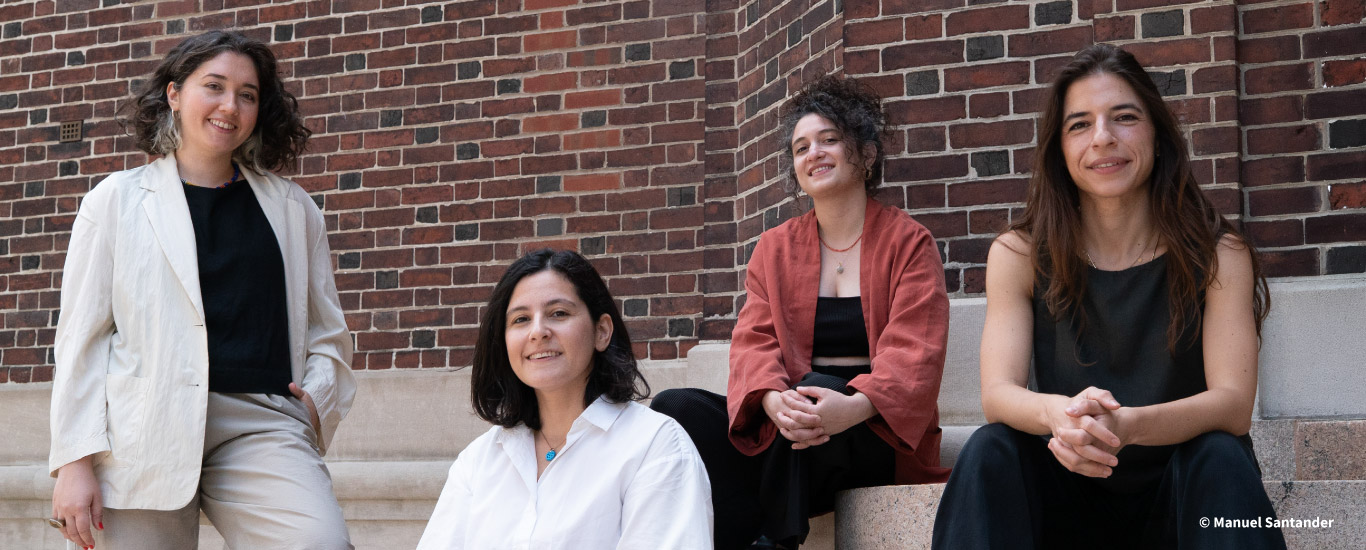
Photograph: Manuel Santander
ba-be commons is a research collective founded by Başak Eren, Asya Ece Uzmay, Beril Sarısakal Erkent, and Ece Yetim, whose collaboration began at the Faculty of Architecture at Istanbul Technical University. Eren graduated in 2015, while the other members completed their architecture degrees in 2016. They later reunited around shared research interests while pursuing academic work across the fields of architectural history and theory, design, and architectural representation at universities across the United States.
Today, Başak Eren is a PhD candidate at the University of Pennsylvania Weitzman School of Design; Asya Ece Uzmay is a PhD candidate at Cornell University College of Architecture, Art, and Planning (AAP); Beril Sarısakal Erkent is a PhD candidate at Columbia University Graduate School of Architecture, Planning and Preservation (GSAPP); and Ece Yetim teaches at the Wentworth Institute of Technology and the Rhode Island School of Design (RISD). Their work explores architectural history and theory, architectural representation, and design research. Their proposal for the Türkiye Pavilion at the 2027 International Architecture Exhibition of La Biennale di Venezia, Spolia Futures, brings together research they have developed across different countries and institutions over the years into a shared architectural proposition.
Başak Eren
Başak Eren is an architect, educator and researcher. Eren is a PhD candidate in Architecture, History and Theory at the University of Pennsylvania Weitzman School of Design. Her research focuses on the practices, recognition, and archival representation of displaced architectures in the 20th century. Utilising an intersectional approach, her research focuses on the complex relationship between national and global histories of architecture. Her work has been supported by the Canadian Centre for Architecture (CCA), Penn Global, and the University of Pennsylvania's Professional Student Assembly (GAPSA). Eren holds a bachelor’s degree in architecture and a master’s degree in architectural design from Istanbul Technical University, Türkiye. Prior to her PhD, she served as a faculty member at MEF University in Istanbul and practiced architecture, earning recognition through award-winning work and built projects spanning scales from urban design to installation. Eren continues to explore the relationship between her academic research and design practice.
Asya Ece Uzmay
Asya Ece Uzmay is an architect, educator, and researcher. Her work examines the histories of architecture and the built environment in late Ottoman and post-Ottoman geographies, engaging in questions of modernity, imperialism, labour, infrastructure, and agriculture, with a particular focus on land, water, and resource management. Her work has been generously supported by the Canadian Centre for Architecture (CCA), the Einaudi Centre for International Studies, and the Society of Architectural Historians, among others. Her writings appeared in edited volumes and journals, both in Turkish and English. She participated in several exhibitions at SALT in Istanbul, held teaching positions at Cornell University, Barnard College, and Kadir Has University; and worked as a researcher at the Istanbul Studies Centre. Uzmay is a PhD candidate in the History of Architecture and Urban Development (HAUD) programme at the Cornell University College of Architecture, Art, and Planning (AAP) and holds an MSc from Kadir Has University with a B.Arch from Istanbul Technical University.
Beril Sarısakal Erkent
Beril Sarısakal Erkent is an architect, educator, and researcher. She is a doctoral candidate in Architecture at Columbia University Graduate School of Architecture, Planning and Preservation (GSAPP). Her research focuses on the epistemologies of design and architecture in the late Ottoman and early Republican periods, technocracy in architectural history, and the body politics of empires. Her work has been supported by Yale University, Decorative Arts Trust, College Art Association, as well as Columbia GSAPP. Beril earned both her bachelor’s and master’s degrees in architecture and architectural history, respectively, from Istanbul Technical University. Before beginning her PhD, she worked as a researcher at cultural institutions like SALT Galata and taught as a faculty member at MEF University in Istanbul. Her research has been published in International Journal of Islamic Architecture (IJIA) and The Muslim World, among others.
Ece Yetim
Ece Yetim is an architect, educator, and designer. She is a Visiting Assistant Professor at Wentworth Institute of Technology School of Architecture and Design, and Adjunct Faculty at the Rhode Island School of Design (RISD). Her work focuses on representational practices, using architectural drawing as a political medium to investigate public space, collective agency, and the forms of solidarity that architecture can foster. She is the co-founder of KOMM.unity, a design collective that develops transformative furniture that strengthens community connections. Previously, Yetim worked at Höweler + Yoon Architecture, Studio Daniel Libeskind, and Atelier Bow-Wow where she contributed to projects ranging from exhibition design to museum projects. Yetim holds an M.Arch from Princeton University and a B.Arch from Istanbul Technical University. Her published works include Shadowing the Silence: A Spatial Rewriting of Myths (with Aslıhan Şenel, 2023), an editorial contribution to Lina Bo Bardi: Material Ideologies (2022), and ‘Different Scales of Solidarity’ (MONU, 2021).
The 20th International Architecture Exhibition of La Biennale di Venezia
The 20th International Architecture Exhibition of La Biennale di Venezia will be held between 8 May and 21 November 2027 (previews on 6–7 May) in Giardini, Arsenale, and various sites around Venice. The title and theme of the exhibition have been announced by the president of La Biennale di Venezia, Pietrangelo Buttafuoco, and the curators Wang Shu and Lu Wenyu as Do Architecture — For the Possibility of Coexistence Facing a Real Reality.